1. Introduction to Russia Bitumen Market
The Russia bitumen market is an important segment of the country’s downstream petroleum industry. As one of the world’s largest crude oil producers, Russia has a strong refining base that supports the production of heavy petroleum products, including bitumen. Bitumen is mainly used in road construction, highway maintenance, infrastructure development, waterproofing, and selected industrial applications. Due to Russia’s vast geography and continuous need for transport infrastructure development, domestic demand for bitumen remains relatively stable, especially during the warmer construction season.
In addition to domestic consumption, Russia also plays a role in the regional and international bitumen trade. Its geographical position provides access to markets in Eastern Europe, Central Asia, the Caucasus, China, and other nearby regions. However, the market is influenced by several external and internal factors, including crude oil price fluctuations, refinery operating rates, transportation costs, seasonal construction activity, export restrictions, and international sanctions. These factors shape both the competitiveness and direction of Russia’s bitumen supply.
2.Indicative Russia Bitumen Prices by Export Port
The following table provides indicative export price ranges for Russian bitumen based on public market references, trader quotations, and industry estimates.
|
Port / Hub
|
Grade
|
Packing
|
Indicative FOB Price (USD/MT)
|
Notes
|
|
Novorossiysk
|
60/70
|
Drum
|
220–280
|
Negotiable, min 5000 MT
|
|
St. Petersburg
|
60/70
|
Drum
|
210–270
|
Negotiable, min 5000 MT
|
|
Ust-Luga
|
60/70
|
Drum
|
200–265
|
Negotiable, min 5000 MT
|
|
Primorsk
|
60/70
|
Drum
|
215–275
|
Negotiable, min 5000 MT
|
|
Vysotsk
|
60/70
|
Drum
|
205–270
|
Negotiable, min 5000 MT
|
Disclaimer: The above prices are indicative estimates compiled from publicly available market information and trader quotations. Actual transaction prices may vary depending on volume, contract terms, freight costs, insurance, payment conditions, timing, and market volatility. These figures should not be considered official or binding quotations.
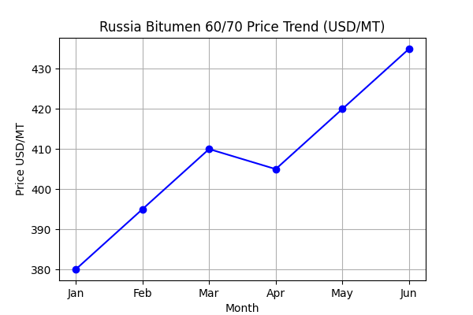
3. Historical Russia Bitumen Price Trend
The historical trend shows the monthly price movement of Bitumen 60/70 in USD per metric ton.
|
Month
|
Average Price (USD/MT)
|
|
January
|
190
|
|
February
|
198
|
|
March
|
205
|
|
April
|
218
|
|
May
|
232
|
|
June
|
245
|
4. Russia Bitumen Production Capacity
Russia’s bitumen production capacity is closely linked to its large refining sector and the availability of heavy refinery residues such as vacuum bottoms. Major Russian oil companies, including Rosneft, Lukoil, Gazprom Neft, Tatneft, and Bashneft, operate refineries that produce different grades of paving and industrial bitumen. Production is typically derived from vacuum distillation residues and may involve additional processing such as air oxidation or blending to meet required technical specifications.
Actual production levels can vary depending on refinery maintenance schedules, seasonal demand, and domestic infrastructure activity. During spring and summer, when road construction projects are most active, bitumen output and distribution usually increase. In contrast, winter conditions reduce domestic paving activity, which can lead to lower production, inventory accumulation, or redirection of supply toward export markets. Logistics constraints, railway availability, storage infrastructure, and refinery modernization programs also affect Russia’s effective bitumen supply capacity.
5. Major Russian Bitumen Refineries
Major refineries produce a wide range of bitumen grades and include high-performance blends for industrial applications.
|
Refinery
|
Location
|
Capacity (MT/year)
|
|
Omsk
|
Siberia
|
1,200,000
|
|
Ryazan
|
Central Russia
|
900,000
|
|
Kirishi
|
Northwest Russia
|
850,000
|
|
Yaroslavl
|
Central Russia
|
700,000
|
|
Novokuibyshevsk
|
Volga Region
|
650,000
|
6. Russia Bitumen Export Statistics
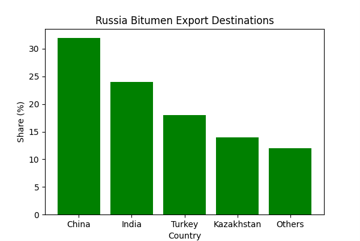
Russia exports part of its bitumen production to neighboring and regional markets. Key export destinations have traditionally included countries in Central Asia, the Caucasus, Eastern Europe, and China, depending on trade routes, pricing, and regulatory conditions. Bitumen may be exported in bulk, drums, jumbo bags, or in some cases as related feedstock such as vacuum residue. Export volumes are usually seasonal, increasing during periods of higher construction activity in destination markets.
In recent years, Russia’s bitumen export patterns have been affected by sanctions, changes in trade routes, banking restrictions, and higher logistics costs. These developments have encouraged exporters to shift focus toward alternative markets and non-traditional routes. To evaluate Russia’s export performance accurately, analysts usually examine annual export volume, export value, destination countries, product grade, transportation mode, and average export price. Such indicators help determine Russia’s competitiveness compared with other bitumen exporters such as Iran, Iraq, Turkey, and Gulf countries.
7. Main Export Destinations
|
Country
|
Export Share (%)
|
|
China
|
32
|
|
India
|
24
|
|
Turkey
|
18
|
|
Kazakhstan
|
14
|
|
Others
|
12
|
8. Russia Bitumen Grades and Specifications
Russia produces various bitumen grades designed for road construction, infrastructure projects, and industrial applications. The most common products include penetration grades such as 40/60, 60/70, 70/100, and 100/150, which are classified based on needle penetration at a standard temperature. Harder grades are usually suitable for warmer climates or heavy traffic loads, while softer grades may be preferred in colder regions where flexibility and resistance to thermal cracking are important.
Technical specifications for Russian bitumen typically include penetration value, softening point, ductility, flash point, viscosity, solubility, loss on heating, and penetration index. These parameters may be measured according to Russian GOST standards or international standards such as ASTM and EN, depending on the target market. For export customers, compliance with destination-country specifications is critical because bitumen performance must match local climate, pavement design, and road engineering requirements. As a result, Russian suppliers may adjust grades, packaging, and quality specifications according to buyer demand.
9. Market Analysis and Future Outlook
The Russia bitumen market is shaped by three major drivers: refinery production capability, domestic road construction demand, and export market access. Domestic consumption is supported by road repair, highway expansion, regional infrastructure programs, and government-funded transport projects. Given Russia’s large territory and harsh climate, continuous road maintenance remains necessary, which supports long-term demand for bitumen. However, annual consumption can fluctuate depending on construction budgets, weather conditions, and the timing of public infrastructure projects.
The future outlook for Russia’s bitumen market presents both opportunities and risks. On the opportunity side, Russia benefits from a large crude oil base, significant refining capacity, and access to nearby regional markets. On the risk side, sanctions, trade restrictions, logistics challenges, environmental regulations, and competition from Middle Eastern and Asian suppliers may limit market growth. In the coming years, the development of polymer-modified bitumen, improved quality control, more flexible logistics networks, and stronger focus on Asian markets could help Russia maintain its position in the global bitumen industry.
10. Frequently Asked Questions
How is the price of Russian bitumen determined?
Price depends on crude oil costs, refinery output, transport logistics, exchange rates, and market demand.
Who are the main buyers of Russian bitumen?
Primary buyers include China, India, Turkey, Kazakhstan, and other Asian and African countries.
Where can I see weekly Russia bitumen prices?
Weekly prices are published on the Price section of our website with regular updates.
What types of bitumen are produced in Russia?
Bitumen 60/70, 85/100, VG30, VG40, and polymer-modified bitumen (PMB).
What is the total annual production of bitumen in Russia?
Russia produces over 8 million metric tons of bitumen annually.
Which Russian refineries are major bitumen producers?
Omsk, Ryazan, Kirishi, Yaroslavl, and Novokuibyshevsk are key refineries.
11.Resources
1. Bitumen Magazine — https://bitumenmag.com
2. Argus Media — https://www.argusmedia.com
3. S&P Global Commodity Insights (Platts) — https://www.spglobal.com/commodityinsights
4. ICIS — https://www.icis.com
5. Rosneft — https://www.rosneft.com
6. Gazprom Neft — https://www.gazprom-neft.com
7. Lukoil — https://www.lukoil.com
8. Russian Ministry of Energy — https://minenergo.gov.ru
9. International Energy Agency (IEA) — https://www.iea.org
10. UN Comtrade Trade Statistics — https://comtradeplus.un.org